
How advertising opportunities are created, auctions are resolved, and creatives are delivered on Connected TV.

A pause ad is an advertisement that appears when a viewer pauses the content. The application keeps the video playback on hold and uses part of the screen, or the entire screen, to display an ad creative. When the viewer resumes playback, the ad disappears.
This format allows monetizing a moment that already exists within the viewing session without introducing an additional interruption to the program. However, making it work involves more than simply detecting a button press on the remote control. The pause must be turned into an advertising opportunity, a suitable campaign must be selected, its assets must be delivered, and the creative must be displayed before the opportunity expires.
In July 2026, IAB Tech Lab finalized the format and signaling guidelines for its CTV Ad Portfolio. The work includes pause ads and establishes how to describe these experiences so that buyers, sellers, and technology vendors can interpret them consistently. [1]
To explain the process, we will use a specific programmatic architecture: a CTV application queries the publisher's ad server, it requests demand from an SSP, which receives bids from DSPs. Once the ad is selected, the application downloads and displays the creative. It is a reference architecture. A direct sales campaign can bypass the auction, and a single vendor can combine several of these functions.
The workflow has two phases that are worth distinguishing. The first decides which ad gets the slot and under what conditions. The second retrieves its assets and renders them on the TV screen. Winning the first phase does not guarantee completing the second.
There is also a constraint that affects the entire system: the viewer can press play again at any time. The integration must handle that resumption, even if the auction or download is still in progress.
The diagram shows the messages of an opportunity that ends with a served ad. Steps 2 through 5 correspond to the demand query and the auction, steps 6 through 9 to the delivery and display of the creative.
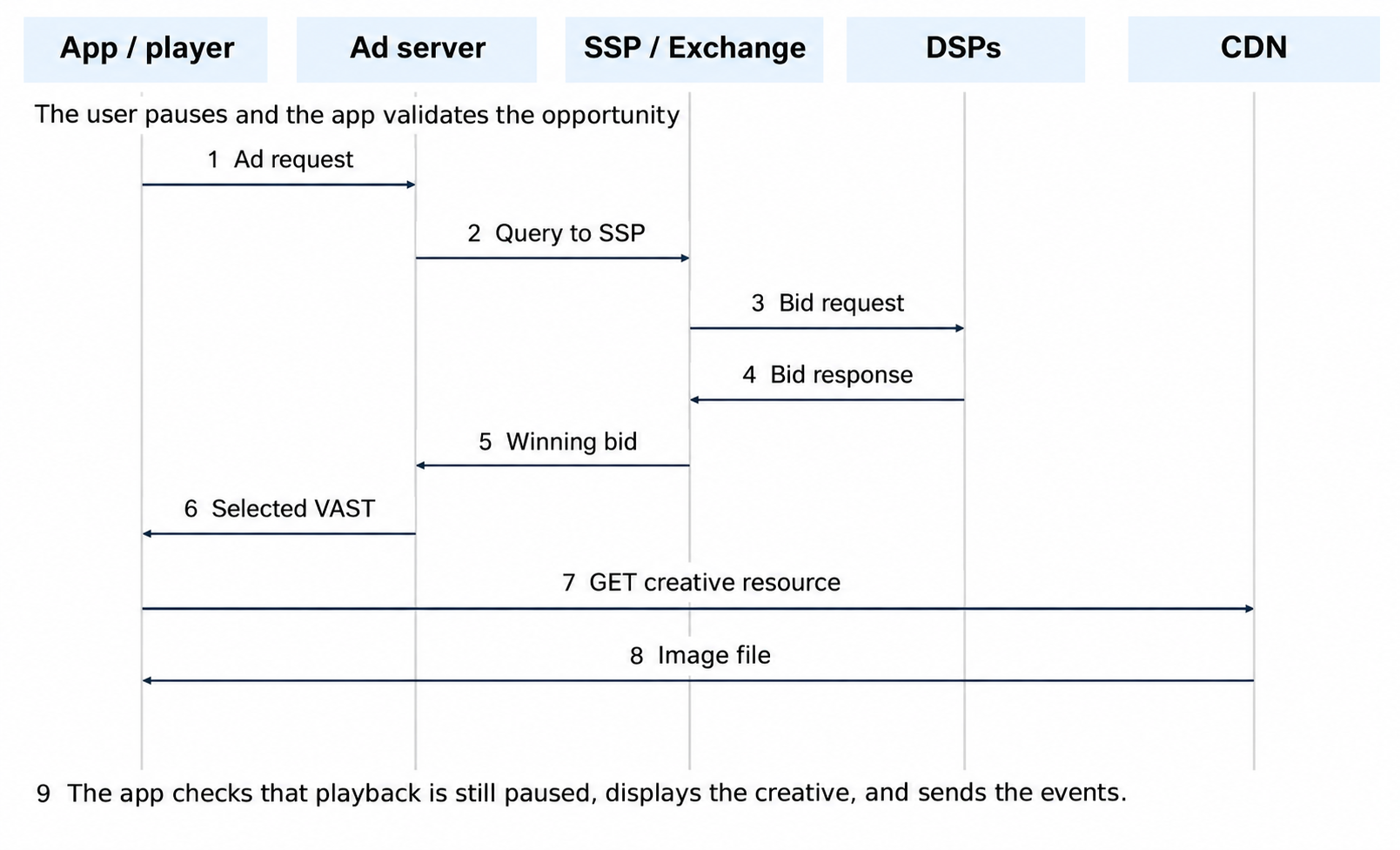
1.- The application detects the pause, checks its eligibility, and queries the ad server. The activation delay and frequency rules are validated, a freeze due to a lost connection should not be confused with a voluntary pause.
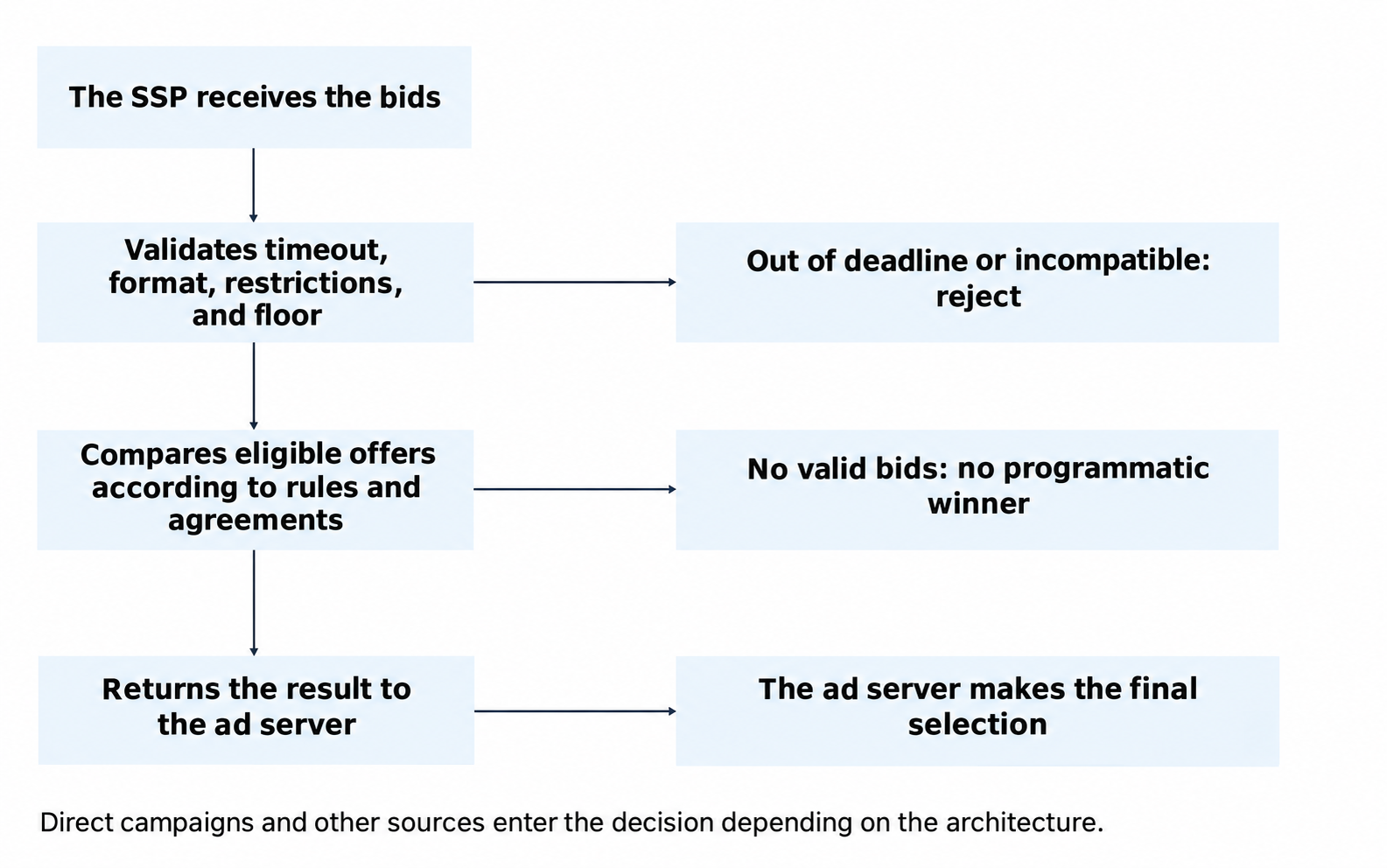
2 to 5. The ad server queries the SSP. It sends a bid request to the DSPs, receives their bids, and returns the result. The ad server applies the final selection according to the campaigns and sources it coordinates.
6 to 9. The application receives the selected VAST, gets the asset URL, and downloads it from the CDN, the content delivery network. Before displaying it, it verifies that the pause is still active. Then it renders the piece and fires the corresponding tracking events.
The activation time and the auction timeout are different. YouTube documents ten seconds before showing its pause ad, Bitmovin describes one second before the pause is eligible to resolve it. These are rules of those specific products, not a universal duration. [2][3]
The SSP describes the opportunity using OpenRTB. The DSP interprets that request and decides whether to participate with any of its campaigns. The bid is calculated automatically based on the campaign, available context, budget, and buying rules.
The bid request identifies the application and the placement. In IAB signaling, imp.video.plcmt = 5 declares a pause ad. The video object describes the advertising context here, the creative may be a static image. [4]
Other fields specify the opportunity: app.bundle identifies the application; mimes declares the supported asset types; bidfloor expresses the minimum price when used; and tmax sets the deadline to receive bids, including network latency. A deal ID links the purchase to a private deal. Audience data depends on availability and applicable permissions. [5]
The bid response returns price, the bid CPM; crid, the creative identifier; and adm, which may contain the VAST. The image does not travel as a file inside that response. [5][6]
In a first-price auction, with eligible bids of 12 and 10 euros CPM, with no other priorities, the 12-euro bid wins at the submitted price. The example assumes comparable amounts and the same conditions. If the 12-euro bid arrives late or fails to meet the format requirements, it is disqualified. The SSP winner must still pass the ad server’s final selection when it coordinates other sources or priority campaigns.
VAST is the XML document used to communicate ad assets and tracking events. For pause ads, the IAB guideline uses NonLinearAds. The response can be InLine, with the final information, or a Wrapper that points to another server. Wrappers are resolved until the ad is obtained; each hop adds a network call. [4][7]
This illustrative snippet represents a static creative. It is part of a VAST response, not a complete document:
<NonLinearAds>
  <NonLinear width="1280" height="720">
    <StaticResource creativeType="image/png">
      <![CDATA[https://cdn.example.com/pause/ad.png]]>
    </StaticResource>
  </NonLinear>
</NonLinearAds>
StaticResource points to the asset, and creativeType indicates its type. The application downloads the file, decodes it, and presents it in the agreed container. Bitmovin documents PNG and JPEG for its pause ad implementation. That specific capability does not allow assuming video or interactivity support in any player. [3]
The download is asynchronous: the request goes out and its result arrives later. Between those two moments, the player state can change. To prevent a late-arriving creative from appearing over the video content, the implementation must bind each operation to its opportunity and re-validate the state before rendering.
A simple state machine allows controlling the journey. The opportunity goes through validation, request, loading, and presentation. A resumption invalidates that opportunity at any phase; if a later response arrives, it is discarded. Local cancellation does not require all servers to stop work already initiated, but it does prevent displaying the ad out of context.
When the piece is presented, the application preserves its aspect ratio and keeps the control to return to the content accessible. If the download fails or there is no ad, the session continues without blocking playback.
Having SSAI for channel spots does not solve this layer. Server-side insertion may participate in the decision or signaling; the player or the user interface must manage what appears while the content remains paused.
An integration must separate the opportunity, the award, and the presentation. This distinction explains why the number of won auctions can be higher than the number of served ads: some pauses end during download, files fail, and responses arrive after a timeout.
OpenRTB provides nurl for the win notification and burl for the billable event defined by the exchange. These notices have the meaning established by the integration and the contract. A win notification does not prove that the creative actually appeared on the TV screen. [5]
Player events describe the actual delivery. In Bitmovin’s implementation, impression and creativeView fire when the creative becomes visible; notUsed identifies a loaded asset that was ultimately not displayed. Close tracking, display duration, and errors are also supported. [3] Resuming content and clicking an explicit close action are different actions and must be recorded according to the semantics of each event.
To verify the process, identifiers are needed to link the pause, the auction request, the bid, and the creative with the player events. Timestamps make it possible to locate bottlenecks: ad decisioning, VAST resolution, downloading, or rendering. If a notification is retried, deduplication prevents counting the same event twice.
The auction timeout only controls part of the total time. A fast response does not make up for a slow wrapper chain or a heavy file. Preloading assets reduces wait times in architectures that support it, but it requires managing their expiration and the ads that will never be used. Bitmovin documents, for its solution, a request triggered when the pause becomes eligible, without pre-caching. [3]
Verification must also check the user experience: resuming during the auction, returning to video content while the image is downloading, pausing multiple times, and receiving a response with no ad. These tests show whether the system handles its errors without passing them on to the viewer.
Finally, presenting a creative does not prove human attention. Someone may have left the living room. Viewability evaluates technical visibility conditions; its availability depends on the environment. Google indicates that its YouTube Pause ads do not support first- or third-party viewability measurement. [2] Reporting must explain what was measured and with what coverage.
The format requires a technical agreement between supply and demand. The SSP must correctly describe the ad placement, and the DSP must return a compatible creative. The ad server enforces the commercial terms, while the application controls when the ad is displayed and when playback resumes. When these responsibilities are clearly defined, discrepancies are easier to identify and resolve.
Before scaling an integration, it is worth assessing how long viewers actually keep content paused, which devices support the format, and what percentage of opportunities result in an ad being displayed. A high number of ad requests means little if a significant share of creatives arrives after the viewer has already resumed playback.
For advertisers, evaluation involves placement, frequency, creative quality, and proof of delivery. A QR code makes it easier to continue the experience on mobile. Scanning it records a specific action, but it does not replace brand-effect measurement or, on its own, demonstrate incremental sales.
Pause ads become a viable advertising product when the buying process and delivery process describe the same experience. The standard provides a common language. The integration must turn it into an ad that arrives on time, appears in the agreed placement, and disappears when playback resumes.
Accessed October 23, 2026. The diagrams describe the reference architecture of the article. The bid example, XML snippet, and state machine are illustrative.
At tvads we have a professional team able to advise you on this field and guide you in any area of your streaming advertising business, advising you or even operating it on your behalf if necessary
All author posts