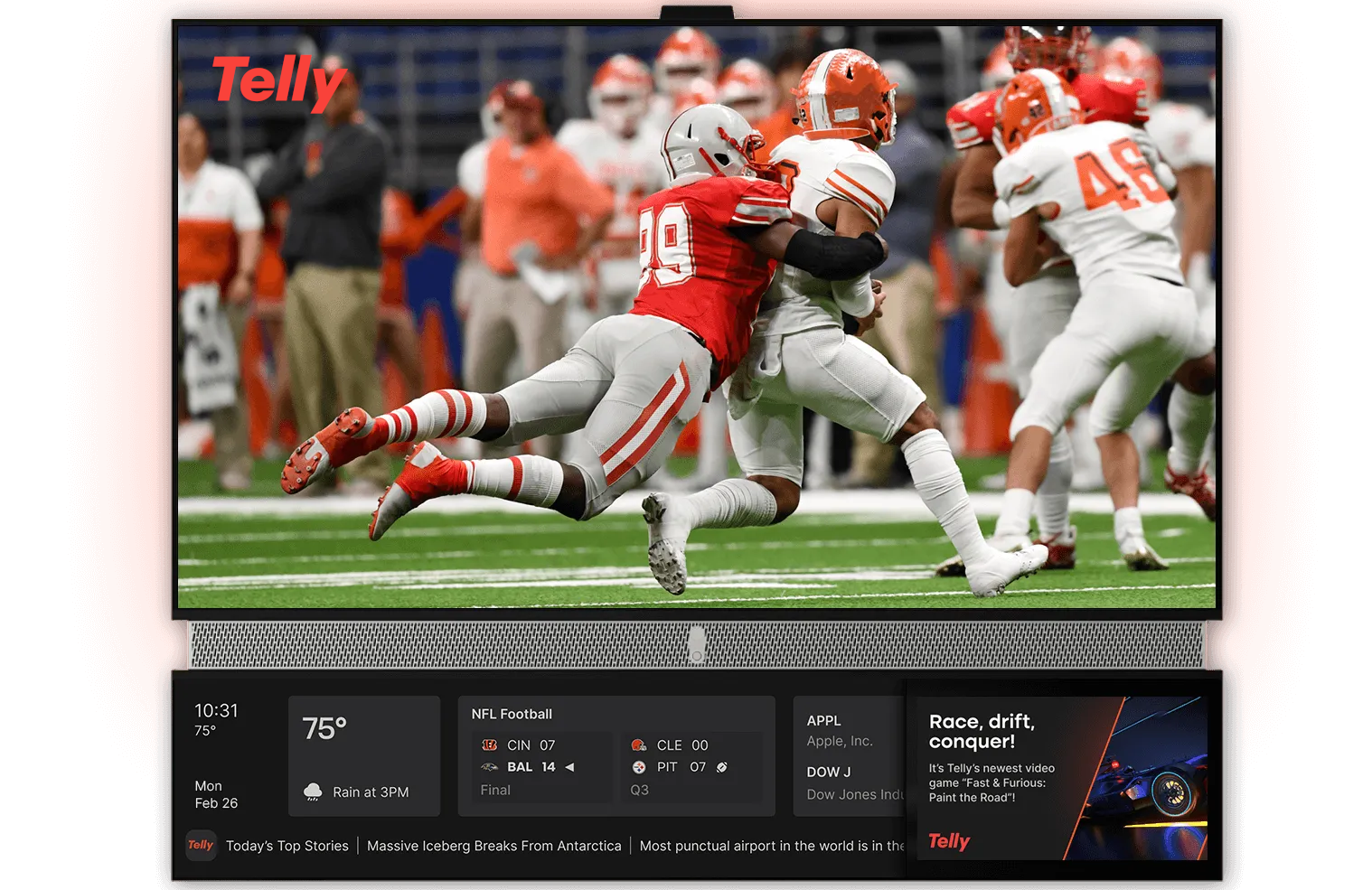

In May 2023, a startup named Telly unveiled a proposal that immediately caught the attention of both the television and advertising industries. Founded by Ilya Pozin (co-founder of Pluto TV) the company announced it would give away 500,000 televisions in the United States. This was not, however, a conventional TV set.
The concept was simple to explain, yet far more complex to execute. Telly had designed a 55-inch 4K HDR television featuring a secondary 9-inch screen located beneath the primary display. While the user watched content on the main screen, this second surface remained active, displaying ads, news widgets, sports scores, weather updates, and other interactive elements. Consequently, advertising didn't need to wait for a commercial break or interrupt the viewer's content.
The value exchange was clear: users received a free TV, which the company valued at around $1,000, and in return, Telly secured a permanent advertising space inside the home. The company managed to log 250,000 sign-ups within the first two weeks of launch and announced plans to deliver 500,000 units throughout 2023.
The pitch also successfully attracted investment. Telly initially raised a nine-figure seed round backed by investors such as Gary Vaynerchuk and Rich Greenfield, although the company has never publicly disclosed a total consolidated figure for its equity funding. Later, according to an investor update reported by The Verge, Telly secured $350 million in debt financing across two rounds.
Up to this point, the story aligned perfectly with the playbook of much of the platform economy: the hardware wasn't actually the product, it was simply the vehicle to acquire users and build an audience that could later be monetized through advertising. The problem arose when it came time to convert that initial interest into actual TV sets installed in households.
By late 2025, Telly had around 35,000 TVs active in households, a starck contrast to its initial 500,000-unit target and the multi-million-device scale it later envisioned. The company also had to navigate significant logistical hurdles. According to The Verge, approximately 10% of units shipped via FedEx were damaged in transit, eventually prompting Telly to switch logistics providers. In a business model built on free hardware, manufacturing, financing, shipping, and installing each device represents an upfront cost the company must absorb before it can monetize the audience, making the size of the installed base particularly critical.
At the same time, available data suggests that monetization per device can be substantial. According to the same investor update, Telly reached an annualized revenue run rate of approximately $22 million in Q3 2025. With 35,000 active TVs, that translates to roughly $52 per month per device, a figure The Verge contrasts with the ad ARPU of hardware makers like Roku and Vizio. This metric is significant because it demonstrates that a secondary screen can generate notable ad revenue, yet it also sheds light on the model's core vulnerability.
However, generating high monetization per device is one thing, building a wide enough household footprint for that inventory to achieve meaningful scale in the ad market is entirely another. This highlights Telly's central dilemma: while the economic value of each screen may be compelling, without end-user scale, that value has limited runway.
High average revenue per user does not automatically offset a small active user base when the model requires manufacturing, financing, shipping, and physically installing hardware. The company must bear those capital expenditures before monetizing its audience, and a smaller installed base directly limits the volume of ad inventory it can bring to market. Ultimately, Telly's challenge isn't proving that a second screen can drive ad revenue, but rather scaling into enough homes to make that inventory commercially significant within the CTV ecosystem.
In any case, Telly remains operational and continues to pursue the vision it was built upon. Its website still offers the TV for free, and around that secondary display, the company has gradually developed a considerably more sophisticated advertising proposition, complete with interactive formats, QR codes, shoppable experiences, tune-in prompts, and measurement tools linked to its viewer detection technology. What started as a simple idea of placing ads alongside content has thus evolved into a connected ad inventory offer tied directly to the device and the household.
What is interesting is that, while Telly has been refining that side of the business, the broader market has evolved in a direction that makes its value proposition harder to differentiate. Major OEMs and platforms already boast tens of millions of installed TVs and can monetize home screens, interfaces, recommendations, or various OS-level real estate without having to absorb the cost of giving away hardware to build that audience. Giants like Samsung, LG, Roku, Amazon, and Google therefore start with a baseline advantage that Telly must build from scratch: a sufficiently large installed base upon which to expand ad inventory.
This is likely where the most compelling chapter of Telly's story lies. The company proved capable of turning a catchy concept into a tangible product and demonstrated that there is real economic value in dedicating a portion of the TV strictly to advertising. What it has yet to prove is whether that value can sustain a large-scale distribution model. In a business like CTV, where inventory pricing hinges heavily on scale, targeting capabilities, and reachable audience size, the gap between having a strong idea and building a market-moving platform remains substantial.
Telly sought to solve a fundamental question of connected television in a very unique way: who pays for the device when content is becoming cheaper or even free? Its answer was to shift part of that cost onto advertising and transform the TV itself into the ad medium. What remains to be seen is whether the revenue generated per screen is enough to fund putting millions more screens into millions more homes, and, above all, whether the company can reach critical mass before competing platforms monetize those same surfaces with an advantage Telly lacks: having arrived there first through hardware that is already installed.
At tvads we has a professional team able to advise you on this field and and guide you in any area of your streaming advertising business, advising you or even operating it on your behalf if necessary
All author posts